Can You Bring IQOS on a Flight?
In most cases, you can travel with an IQOS device, but the device, tobacco sticks and actual use of IQOS are governed by three different sets of rules: aviation safety, airline policy and the laws of your destination country.
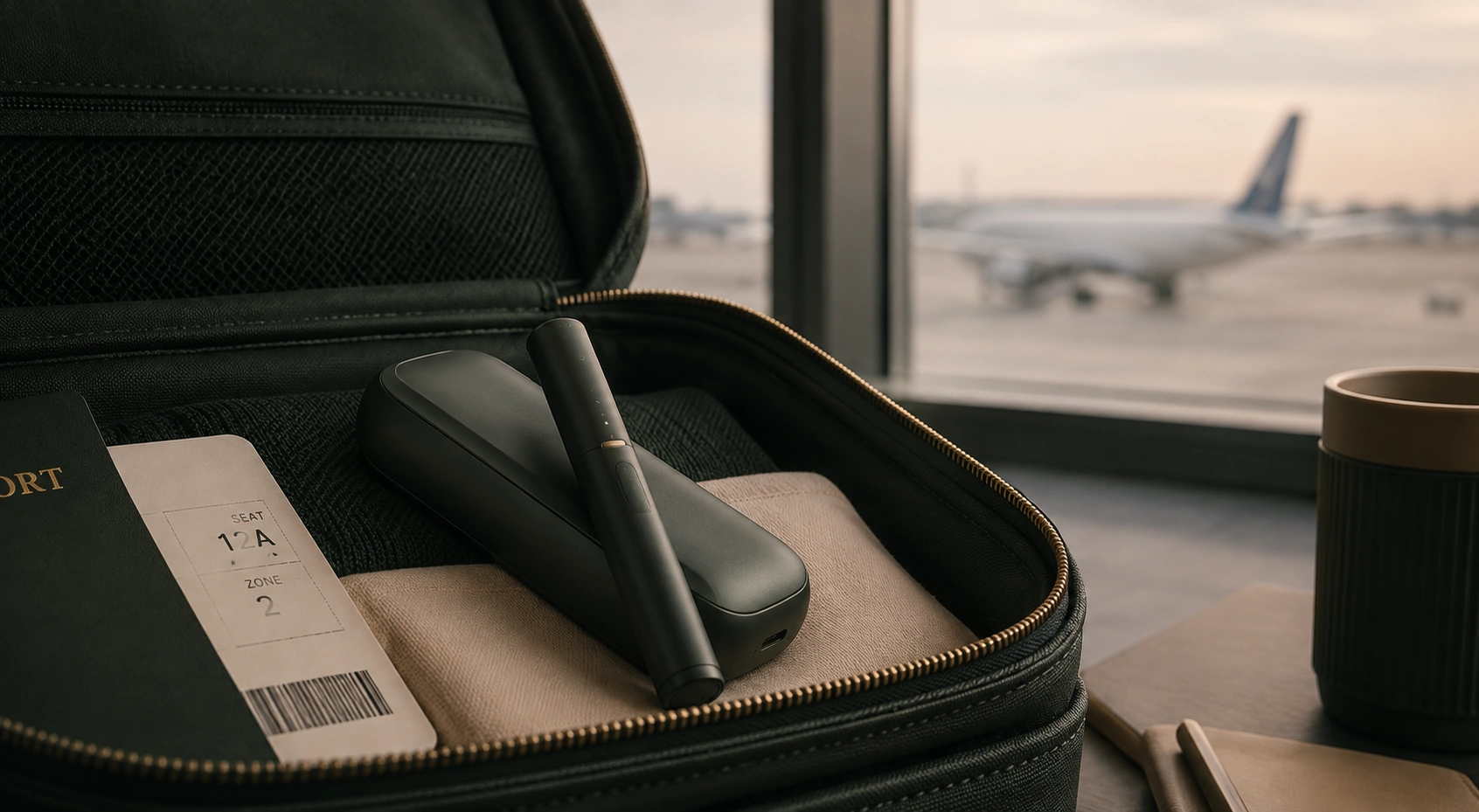
Yes, you can usually take IQOS on a plane, but the safest rule is to keep the device in your carry-on baggage or on your person—not inside checked luggage.
Keep it completely switched off and protected against accidental activation. Do not use or charge it during the flight. TEREA, HEETS and other tobacco sticks are treated separately and may be limited or prohibited by customs at your destination.
| Item or action | General flight rule | What you should do |
|---|---|---|
| IQOS device | Carry-on baggage | Switch it off, prevent accidental activation and keep it inside the aircraft cabin. |
| Checked baggage | Avoid | Do not pack the battery-powered IQOS device in your checked suitcase. |
| TEREA or HEETS sticks | Customs dependent | Check the tobacco allowance, declaration rules and product restrictions for every destination and transit country. |
| Using IQOS onboard | Prohibited | Never activate or use IQOS inside the aircraft cabin or lavatory. |
| Charging onboard | Prohibited | Do not connect the device to a seat socket, USB port or power bank during the flight. |
| Airport use | Local rules apply | Use IQOS only where the airport explicitly permits tobacco use, normally inside a designated smoking area. |
This distinction is especially important when travelling to markets where heated tobacco is prohibited or has not been authorized. Review our guide explaining why IQOS may be banned or restricted in some countries before packing the device for an international journey.
Keep the Device With You
Pack IQOS in your cabin bag or personal item where a battery incident can be noticed and managed by the cabin crew.
Do Not Use or Charge It
Being allowed to carry the device does not give permission to activate, use or recharge it while onboard.
Check the Destination
The device may be allowed by the airline but prohibited by national tobacco, import or possession laws after landing.
Aviation guidance checked against current IATA and FAA passenger battery rules. Individual airlines and national authorities may impose stricter requirements, so always check your operating airline before departure.
Should IQOS Go in Carry-On or Checked Baggage?
Pack your IQOS device in your carry-on baggage or personal item. Do not place it inside a suitcase that will travel in the aircraft hold.
Although IQOS heats tobacco rather than e-liquid, airlines generally treat it as a battery-powered smoking device for baggage-safety purposes. The lithium battery and heating system create the same main aviation concern: an accidental activation, short circuit or battery failure that could cause heat, smoke or fire.
Carry-On Baggage
- Keep the complete IQOS kit inside the cabin.
- Switch the device off before packing it.
- Protect it from accidental activation and physical damage.
- Store it somewhere accessible rather than at the bottom of a bag.
- Follow any stricter instructions issued by your airline.
Checked Baggage
- Do not pack IQOS inside your checked suitcase.
- Do not leave the device inside a cabin bag checked at the gate.
- Do not assume switching it off makes hold baggage acceptable.
- Do not pack loose batteries or a power bank in checked baggage.
- Remove the device before handing a bag to airline staff.
What Parts of the IQOS Kit Should Stay in the Cabin?
Keep every battery-powered part of the system with you. Depending on the model, this may include the IQOS holder, pocket charger, all-in-one device or charging case.
| IQOS item | Where to pack it | Important precaution |
|---|---|---|
| IQOS all-in-one device | Carry-on only | Switch it off and protect it from accidental activation. |
| IQOS holder | Carry-on | Keep it secured inside the original case or a protective pouch. |
| Pocket charger or charging case | Carry-on | Protect it from pressure, impact and unintended button activation. |
| USB cable and wall adapter | Carry-on recommended | A cable has no battery, but keeping the complete kit together reduces the chance of losing a component. |
| Power bank | Carry-on only | Protect the terminals and check the airline’s capacity and usage restrictions. |
| TEREA, HEETS or similar sticks | Carry-on or checked | The main limitation is usually the destination’s tobacco and customs rules rather than battery safety. |
If you are unsure which consumables work with your particular device, check our complete IQOS stick compatibility chart before travelling. TEREA sticks, for example, must not be inserted into older blade-based IQOS devices.
IQOS Lithium-Battery Rules for Flights
The rechargeable battery is the main reason IQOS must remain in the aircraft cabin. If a lithium battery overheats or begins emitting smoke, the cabin crew can identify and respond to the incident more quickly than they could inside the inaccessible cargo hold.
Switch IQOS fully off, protect it from damage and keep it accessible throughout the journey. Do not use, recharge or connect it to a power bank while onboard the aircraft.
Switch the Device Completely Off
Do not leave IQOS running, heating or actively charging. Confirm that the holder and charging case are inactive before placing them in your bag.
Prevent Accidental Activation
Use the original case, a fitted protective cover or a separate compartment where other objects cannot press the device’s controls.
Protect It From Crushing and Impact
Do not place the device underneath heavy luggage, bottles or other objects that could damage the casing or battery.
Keep It Accessible
Avoid packing the device deep inside an overhead suitcase. Keeping it in a personal bag under the seat makes it easier to notice unusual heat, swelling, odor or smoke.
Tell the Crew About Any Battery Problem
Immediately alert the cabin crew if the device becomes unusually hot, expands, produces fumes, makes a hissing sound or appears damaged.
Does the IQOS Battery Need Airline Approval?
A normal personal IQOS device uses a relatively small rechargeable battery and will generally fall well below the capacity thresholds that require individual airline approval. However, the airline still has the final authority to refuse an item or apply a stricter policy.
Approval questions are more likely to arise with large spare batteries, high-capacity power banks or numerous battery-powered devices—not with a standard personal IQOS kit. Nevertheless, check the operating airline’s dangerous-goods page rather than relying only on the rules of the company that sold your ticket.
Sources: IATA passenger lithium-battery guidance and FAA PackSafe guidance for battery-powered electronic smoking devices. Airlines and national aviation authorities may impose additional restrictions.
Can You Use IQOS on a Plane?
No. Carrying an IQOS device in the aircraft cabin does not mean you can use it during the flight. Keep the device switched off from boarding until you have left the aircraft.
Do not activate, heat, use or charge IQOS anywhere onboard the aircraft. This includes your seat, the aisle, galley areas and aircraft lavatories.
Using IQOS at Your Seat
Heated tobacco use is not permitted merely because IQOS produces an aerosol instead of conventional cigarette smoke. Airline smoking restrictions still apply.
Using IQOS in the Lavatory
Never attempt to use the device privately inside an aircraft lavatory. Concealed use may trigger a crew response and lead to serious consequences after landing.
Charging During the Flight
Do not charge IQOS through a seat socket, USB port, laptop or power bank while onboard, even when charging facilities are available.
What If the Airline Does Not Mention IQOS Specifically?
Many airline policies use broader terms such as electronic smoking devices, vaping devices, smokeless cigarettes or heated tobacco products. A policy does not need to mention the IQOS brand by name for the restriction to apply.
When the wording is unclear, treat IQOS as prohibited for onboard use. The safe interpretation is that it may be transported under the airline’s battery rules but must remain switched off throughout the flight.
| Situation | Can you use IQOS? | Correct action |
|---|---|---|
| While boarding | No | Switch it off before entering the aircraft and store it safely. |
| Before takeoff | No | Do not assume use is allowed simply because the aircraft doors are still open. |
| During the flight | No | Keep the device inactive and do not connect it to a charger. |
| Inside the lavatory | Never | Do not attempt concealed use under any circumstances. |
| After landing | Not automatically | Wait until you reach an authorized area and confirm local rules. |
Can You Use IQOS During a Long-Haul Flight?
Flight duration does not change the rule. IQOS remains prohibited during short domestic flights, overnight journeys and long-haul international services.
Nicotine gum, lozenges or another legally permitted nicotine-replacement product may be more practical for a long journey. Keep any medicine in its original packaging and check entry rules if you are travelling internationally.
Can You Use IQOS Inside an Airport?
Airport rules are not universal. Some airports provide designated smoking rooms or outdoor smoking zones, while others prohibit smoking, vaping and heated tobacco throughout the terminal—including the area after security.
Use IQOS only inside an area clearly marked for smoking or heated tobacco use. Do not assume that a quiet corner, restroom, terrace or empty boarding gate is an authorized smoking area.
Designated Smoking Area
Use may be possible when the airport provides a clearly marked smoking room or outdoor zone and its rules include heated tobacco products.
General Terminal Areas
Do not use IQOS at a gate, in a restroom, restaurant, lounge or corridor unless the location is explicitly designated for tobacco use.
How to Check an Airport’s IQOS Rules
Check the Airport’s Official Website
Search the airport facilities page for “smoking area,” “smoking lounge,” “vaping” or “heated tobacco.” Third-party airport guides may contain outdated information.
Confirm Whether the Area Is Before or After Security
Some airports allow smoking only outside the terminal. Once you pass security, you may have no legal place to use IQOS until reaching your destination.
Check Terminal and Gate Access
A smoking lounge may exist in another terminal but remain inaccessible without leaving the secure area or passing through border control.
Follow Signs and Staff Instructions
Temporary closures, renovations and local restrictions can make an online airport map inaccurate. Follow current signs inside the terminal.
What About Connecting Flights?
Transit passengers must follow the rules of the connecting airport and country, even when they do not formally enter the country. You may also pass through another security screening where the device and tobacco sticks can be inspected.
Before travelling, check every airport on the itinerary—not only the departure and final destination. This is particularly important when the connection requires collecting baggage, changing terminals or passing through customs.
- Check whether each airport has a smoking area.
- Confirm whether it is accessible after security.
- Allow enough time to reach the area and return to your gate.
- Never use IQOS inside a restroom or unmarked area.
- Repack and switch off the device before boarding.
Airport smoking facilities and terminal policies can change. Verify the current rules through the official website of every airport included in your itinerary.
How Many TEREA or HEETS Can You Take Through Customs?
There is no universal international allowance for TEREA, HEETS or other heated-tobacco sticks. Each country decides how these products are classified, how much a traveller may import duty-free and whether they can be imported at all.
Do not automatically treat one TEREA stick as one cigarette for customs purposes. Use the destination country’s specific allowance for heated tobacco products whenever one is published.
If the customs authority does not list heated-tobacco sticks separately, ask the authority or declare the products rather than guessing which tobacco category applies.
Check the Exact Product Category
Look for official wording such as heated tobacco, tobacco for heating, tobacco sticks or novel tobacco products—not only cigarettes.
Check Your Travel Route
Allowances may depend on where you are arriving from, whether the journey is within a customs union and whether you are entering by air, sea or land.
Declare When Unsure
Carrying more than the duty-free allowance is not always prohibited, but you may need to declare the products and pay tax or duty.
Examples of How Allowances Differ
| Destination | How the rules work | What IQOS travellers should know |
|---|---|---|
| Great Britain | Official traveller guidance includes a separate allowance of 200 sticks of tobacco for electronic heated-tobacco devices. | The allowance can be combined proportionally with other tobacco categories. Products above the allowance must be declared. |
| European Union | Tobacco rules differ depending on whether you travel between EU countries or arrive from outside the EU. Individual member states may apply different limits and classifications. | Check the customs authority of the specific member state rather than relying only on general EU cigarette figures. |
| United States | Federal traveller guidance publishes duty-free limits for conventional tobacco categories, but heated-tobacco treatment may require confirmation. | Declare IQOS sticks and check both customs rules and current US product authorization before travelling. |
| Countries restricting heated tobacco | Some jurisdictions restrict the sale, import, distribution or possession of heated-tobacco products. | A normal tobacco allowance does not override a specific legal restriction on IQOS or heated-tobacco products. |
What Factors Can Change Your Tobacco Allowance?
- Your final destination and its national customs rules.
- The country or customs territory you are arriving from.
- Your age and eligibility for an adult tobacco allowance.
- Whether the products are for personal use or commercial purposes.
- The number of sticks, packs or cartons being transported.
- Whether heated tobacco has its own customs classification.
- Whether you are entering by air, sea, road or rail.
- How recently you used another duty-free traveller exemption.
Should You Declare TEREA or HEETS?
Declare the sticks when you exceed the published allowance, when the customs form asks about tobacco products or when you cannot confirm how heated tobacco is classified.
A declaration does not automatically mean the products will be confiscated. Customs officers may permit entry after assessing and collecting the applicable duty. Failing to declare can lead to seizure, financial penalties or a more serious customs violation.
Check Whether IQOS Is Legal at Your Destination
Airline acceptance and customs allowance are only part of the journey. You must also check whether the destination permits the import, possession, sale and use of IQOS and heated-tobacco sticks.
A country may allow travellers to possess a device while prohibiting local sales. Another may permit tobacco sticks but restrict flavored variants, public use, advertising or online purchases. These are different legal questions and should not be treated as a single “IQOS ban.”
| Restriction type | What it means | Possible effect on travellers |
|---|---|---|
| Import prohibition | Travellers may not bring the device, tobacco sticks or both across the border. | Products may be refused entry, confiscated or subject to a penalty. |
| Sales restriction | IQOS products cannot legally be sold or distributed locally. | Personal possession may have separate rules, but replacement sticks may be unavailable. |
| Flavor restriction | Certain flavored or characterizing tobacco products cannot be sold or imported. | Some TEREA variants may be restricted even when tobacco-flavored options remain legal. |
| Public-use restriction | Heated tobacco is covered by smoke-free or tobacco-control laws. | Use may be limited to designated smoking areas after arrival. |
| Product authorization rule | Only specifically approved devices or consumables may be sold. | A product available abroad may not be authorized in the local market. |
How to Verify the Rules Before Flying
Check the Customs Authority
Confirm the personal allowance, declaration procedure and specific treatment of heated-tobacco sticks.
Check Government Tobacco Regulations
Look for import, possession, flavor and public-use restrictions on an official government or embassy website.
Check the Operating Airline
Verify its rules for battery-powered smoking devices, carry-on baggage and onboard charging.
Check Every Transit Country
Connections can create additional legal and security requirements, especially when you must collect luggage or pass border control.
Product ranges also vary considerably between markets. Our guide to regional TEREA availability can help you understand which variants are commonly associated with different countries, but it should not replace current customs advice.
Customs examples checked against current official UK, EU and US traveller guidance in August 2026. Heated-tobacco classifications and national import restrictions can differ, so destination-specific government guidance takes priority.
IQOS Flight Checklist
Use this checklist before every flight. Even if you have travelled with IQOS previously, airline policies, airport facilities and destination laws may have changed.
Device and Battery
- Place the IQOS device in your carry-on or personal bag.
- Keep the holder and charging case inside the cabin.
- Switch every battery-powered component completely off.
- Protect the device from accidental activation.
- Do not travel with a damaged or swollen battery.
- Remove IQOS if your cabin bag is checked at the gate.
Airline and Destination
- Read the operating airline’s electronic-smoking-device policy.
- Check every transit airport for smoking-area availability.
- Confirm whether IQOS can legally enter the destination.
- Check the customs allowance for heated-tobacco sticks.
- Declare tobacco products when required or when unsure.
- Recheck official guidance shortly before departure.
What to Do at Each Stage of the Journey
| Travel stage | What to do with IQOS | Main risk to check |
|---|---|---|
| Before leaving home | Switch it off, inspect the battery and pack it in your cabin bag. | Damaged battery or prohibited destination. |
| Airport security | Keep the device accessible and follow the officer’s screening instructions. | Additional inspection or local airport restrictions. |
| After security | Use it only in a clearly designated smoking area, if one exists. | Terminal-wide smoking and heated-tobacco bans. |
| At the boarding gate | Remove the device before surrendering any cabin bag for gate-checking. | Battery-powered device entering the aircraft hold. |
| During the flight | Keep it switched off and do not use or charge it. | Violation of airline rules and battery-safety requirements. |
| On arrival | Keep the sticks available for declaration and follow local tobacco-use laws. | Customs allowance, import restrictions and public-use rules. |
FAQ About Taking IQOS on a Plane
Can I take IQOS in my hand luggage?
Yes. An IQOS device should normally be carried in your hand luggage or on your person. Switch it off and protect it from accidental activation and physical damage.
Can I put IQOS in checked baggage?
No. Battery-powered electronic smoking devices should not be placed in checked baggage. Remove IQOS before checking a suitcase or surrendering a cabin bag at the gate.
Can I use IQOS during the flight?
No. IQOS must not be activated or used onboard, including at your seat or inside the aircraft lavatory. Carrying the device is not permission to use it.
Can I charge IQOS on the plane?
No. Do not charge the device from a seat socket, aircraft USB port, laptop or power bank during the flight.
Can I take TEREA or HEETS in my carry-on?
Generally, tobacco sticks can be packed in carry-on baggage, but their entry is controlled by the customs and tobacco laws of the destination and any relevant transit country.
Do I need to remove IQOS at airport security?
Screening procedures vary. Keep the device accessible and remove it only when instructed by airport security staff or when local screening rules require electronic devices to be presented separately.
Does IQOS need to remain in its original packaging?
Aviation rules do not normally require the retail box. However, a protective case is strongly recommended, and original packaging or receipts may help identify the device and products during a customs inspection.
Can airport security confiscate IQOS?
The device may be refused or referred for additional inspection if it is damaged, improperly packed or prohibited under local law. Security clearance also does not prevent customs authorities from enforcing destination-country import rules.
Can I take IQOS on a connecting flight?
Usually yes, provided it remains in your cabin baggage. However, you must check the airline, airport and legal requirements for every country included in the itinerary—not only your final destination.
How many packs of TEREA can I take abroad?
The limit depends on the destination, route and local classification of heated tobacco. Use the official heated-tobacco allowance when one is available and declare the products if you exceed it or cannot confirm the applicable category.
FAQ answers reflect general international aviation-safety principles. Your operating airline, airport authority and destination government may apply stricter requirements.
Can You Fly With IQOS?
Yes, you can usually take IQOS on a plane when the device is switched off, protected against accidental activation and carried inside the aircraft cabin.
Never place the device in checked baggage, use it onboard or charge it during the flight. Pack TEREA, HEETS and other sticks only after checking the customs allowance and heated-tobacco laws of your final destination and transit countries.
The airline controls whether the device can fly. Airport authorities control where it can be used inside the terminal. Customs and national law determine whether the device and sticks can legally enter the country. You need to satisfy all three.