NARNAY / Understanding stick labels
A stick can contain no tobacco and still contain nicotine. That is the distinction behind tobacco-free vs nicotine-free sticks, and it matters more than the flavour name or the leaf pictured on the pack.
This guide explains the labels used for heated sticks, with examples from LEVIA, veo and iSENZIA. The aim is to understand the contents, not to rank flavours.
Quick answer
Does tobacco-free mean nicotine-free?
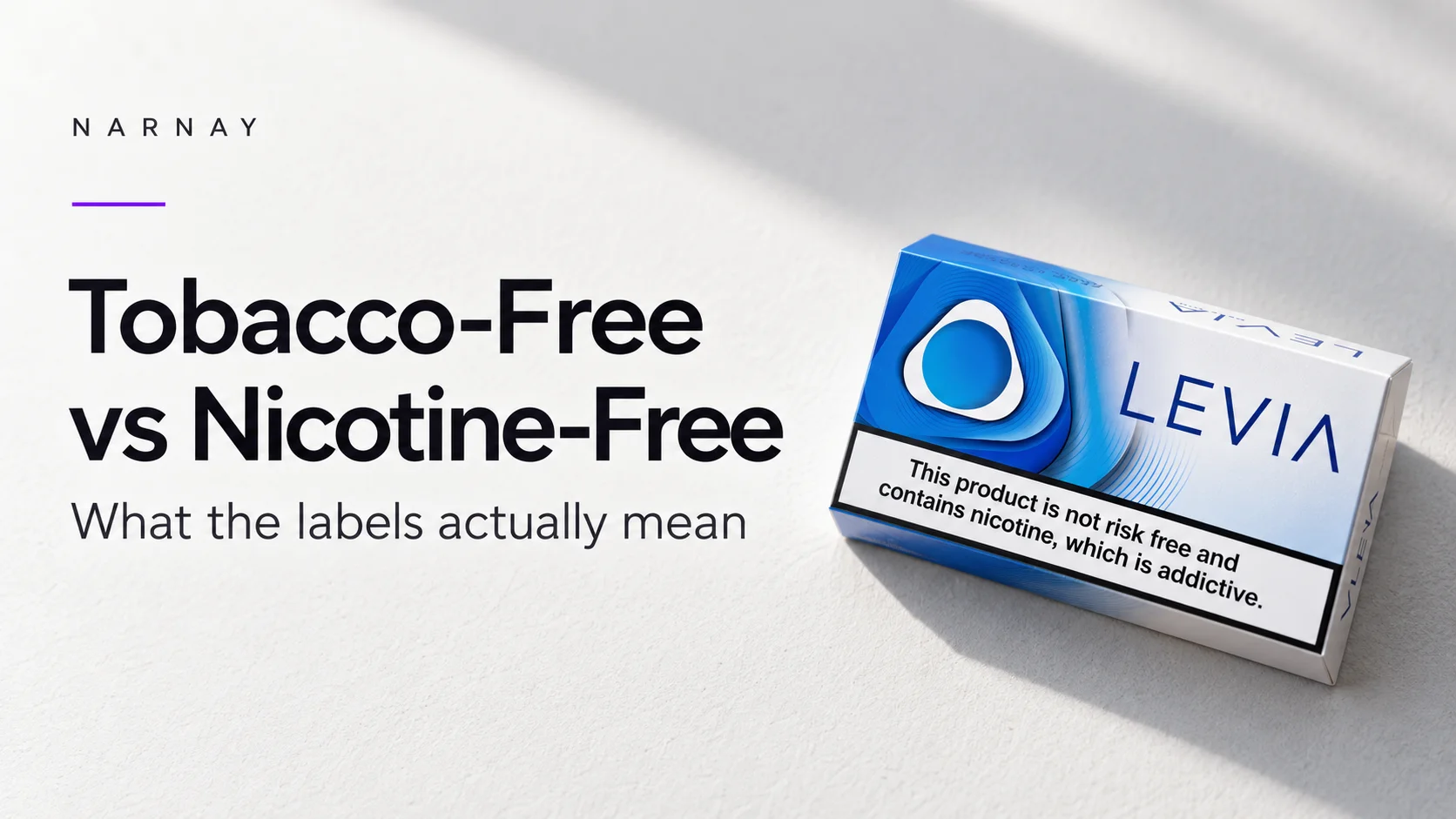
No. Tobacco-free describes the absence of tobacco as the stick’s filling; nicotine-free describes the absence of nicotine. Manufacturers can add nicotine to a non-tobacco carrier. IQOS explicitly describes LEVIA this way. [1]
If you are checking whether a stick contains nicotine, “zero tobacco” is not the answer. Look for the separate nicotine statement.
In this guide
Tobacco-free, nicotine-free and plant-based: three different claims
These terms answer different questions. One concerns tobacco, another concerns nicotine, and the third describes the origin of a material. Read each claim separately rather than letting one stand in for the others.
Scroll sideways on a narrow screen.
| Label | What it describes | What it does not establish |
|---|---|---|
| Tobacco-free / zero tobacco | No tobacco leaf or processed tobacco used as the filling. | Whether nicotine has been added, or where that nicotine came from. |
| Nicotine-free / zero nicotine | A claim that the product contains no nicotine. | The full ingredient list, device compatibility or health effects. |
| Plant-based / plant-derived / herbal | The origin or type of some ingredients. | The absence of nicotine. The wording alone does not establish the absence of tobacco either. |
| Smoke-free / heat-not-burn | A description of how the product is used or generates emissions. | The absence of tobacco, nicotine or harmful emissions. |
Plant-based is especially easy to overread. Tobacco itself is a plant. With a non-tobacco stick, a plant-derived material can simply be the carrier to which nicotine is added.
Which sticks contain tobacco and nicotine?
The examples below show why the distinction matters. They reflect the cited manufacturers’ descriptions; the named tobacco-free ranges are still nicotine-containing products.
Scroll sideways on a narrow screen.
| Stick range | Tobacco filling | Nicotine | Main filling or carrier |
|---|---|---|---|
| TEREA / DELIA [6] | Yes | Yes | Processed tobacco |
| LEVIA [2] | No | Yes, added | Cellulose-based material |
| veo [3] | No | Yes, added | Rooibos-based material |
| iSENZIA [4] | No | Yes | Tea-based material |
A rooibos or tea base tells you what replaces the tobacco filling. It does not tell you whether nicotine was added. Likewise, a cellulose-based plug is a material description, not a nicotine-free claim.
For the differences within IQOS, see our TEREA, DELIA and LEVIA comparison. This guide focuses on what the labels mean across stick families.
How can a tobacco-free stick contain nicotine?
The nicotine and the material holding it do not have to come from the same place. A manufacturer can use a non-tobacco filling and add nicotine separately.
LEVIA is a clear example. IQOS Switzerland describes a cellulose-based carrier infused with nicotine and flavourings. It also states that the nicotine is extracted from tobacco leaves and that no synthetic nicotine is added. [2]
That explains the apparent contradiction: the stick has no tobacco filling, but an ingredient in it still originates from tobacco. “Tobacco-free stick” does not necessarily mean “nothing in this product came from a tobacco plant.”
When the claim is about the nicotine itself, it concerns its origin. FDA uses “non-tobacco nicotine” for nicotine that did not come from the tobacco plant, including nicotine made synthetically. That is still nicotine, and FDA says it remains addictive regardless of its source. [7]
Do not assume every tobacco-free stick uses synthetic nicotine. Do not assume synthetic nicotine means no nicotine, either.
How to tell whether a stick is nicotine-free
Look for an explicit nicotine-free statement for the exact product and variant. A general description of the brand, a retailer’s category name or “herbal” on the front of the pack is not enough.
A specific nicotine claim
“Nicotine-free,” “zero nicotine” or a clearly identified “0 mg nicotine” declaration addresses nicotine. Check what the number refers to and whether the current pack agrees with the manufacturer’s description.
A different kind of claim
“Zero tobacco,” “tea-based,” “herbal” and “plant-derived” do not answer the nicotine question. Neither do a mild flavour, a green pack or a smooth-taste description.
“No added nicotine” is not the same statement
It describes what was added during production, not necessarily the total nicotine present. Nicotine occurs naturally in tobacco, so the ingredient list still matters. [7] Similarly, “low nicotine” describes a reduced amount, not zero.
A label is a manufacturer’s claim, not an independent laboratory result. If the wording conflicts with a nicotine warning or another official description, do not treat the product as confirmed nicotine-free. Ask the manufacturer to clarify the exact variant.
Does tobacco-free or nicotine-free mean safe?
Neither label establishes that an inhaled product is safe. A composition claim tells you about a particular ingredient; a health claim needs evidence about the finished product and its emissions.
For LEVIA specifically, IQOS says “plant-derived” describes its components and does not mean it is safer than other sticks used with IQOS ILUMA. [1] That is an important limit on what the wording can support.
For tobacco-containing heated products, CDC states that use is harmful and that lower levels of some harmful chemicals than cigarette smoke do not make these products safe. [8] This is not a product-specific safety assessment of every herbal or nicotine-free stick.
Even a supported zero-nicotine claim would answer only the nicotine question. It would not, on its own, establish what else is present in the aerosol or the effects of inhaling it.
The same caution applies to quitting claims. A nicotine-free label does not establish that a product helps people stop smoking. CDC notes that heated tobacco products have not been scientifically shown to help people quit; anyone seeking to stop should use evidence-based cessation support. [8]
Tobacco-free does not mean compatible with your device
The words on the ingredient label do not specify the heating system. Two tobacco-free sticks can belong to completely different device families.
- LEVIA: IQOS specifies the ILUMA family and warns against using these sticks with earlier IQOS generations. [2]
- veo: the cited glo FAQ specifies glo HYPER devices. [3]
- iSENZIA: PULZE states that these sticks are designed exclusively for its devices. [5]
Check the exact model and stick format before use. Physical resemblance, an herbal base or the absence of nicotine is not compatibility evidence. Our heated-stick compatibility guide separates the main device systems.
How to read the pack without guessing
Identify the exact stick
Match the range, variant and market on the physical pack to the manufacturer’s information. A statement about one version does not identify the contents of another.
Separate tobacco from nicotine
Record two answers: does it contain tobacco, and does it contain nicotine? If the pack only answers one, leave the other unresolved.
Read the nicotine declaration and warnings
Look beyond the front label. A nicotine warning remains relevant even when the largest words on the pack say “zero tobacco.” Do not interpret an unexplained “0” as a nicotine measurement.
Check the carrier and device instructions
Tea, rooibos and cellulose describe materials. Confirm the permitted device separately and follow the instructions for that exact combination.
Resolve contradictory information
If a listing says nicotine-free but the matching manufacturer page says it contains nicotine, do not guess. Seek clarification before relying on the claim.
This checklist is for reading product information. It does not replace chemical testing or establish a product’s health effects.
NARNAY verdict
Final verdict: check tobacco and nicotine separately
The most useful distinction is between the filling and the nicotine in it. Removing tobacco as a filling does not prevent a manufacturer from adding nicotine to another material.
Read “tobacco-free” as one composition claim. Read “nicotine-free” as another. Treat “plant-based” as a material description, then check the ingredients, nicotine declaration and device instructions that the headline label leaves unanswered.
Frequently asked questions
Are tobacco-free sticks also nicotine-free?
Not necessarily. A tobacco-free stick can contain added nicotine. The two claims describe different parts of the product information, so check both.
Is LEVIA nicotine-free?
No. IQOS describes LEVIA as a zero-tobacco product containing nicotine. The tobacco-free wording does not remove that nicotine content. [1]
Do veo and iSENZIA contain nicotine?
Does herbal or tea-based mean zero nicotine?
No. Those words identify the base material. They do not rule out nicotine added during manufacturing.
Is tobacco-free nicotine the same as no nicotine?
No. The phrase concerns nicotine’s origin. FDA’s non-tobacco nicotine category includes synthetic nicotine, which is still addictive. [7]
Can a nicotine-free stick be used in any IQOS?
No compatibility conclusion follows from a nicotine-free label. Check the exact IQOS generation and the manufacturer’s instructions for the stick. A nicotine claim does not identify its heating format.
Sources and review date
Official product and public-health information checked on 28 September 2026. Manufacturer sources support the stated composition and compatibility; they are not independent safety comparisons. Regional descriptions do not establish worldwide availability.
- IQOS UK: LEVIA FAQ — Zero-tobacco wording, added nicotine and the limits of plant-derived claims.
- IQOS Switzerland: LEVIA composition — Cellulose-based carrier, tobacco-derived nicotine and device restrictions.
- glo Greece: official FAQ — veo ingredients, nicotine and glo HYPER compatibility.
- Imperial Brands: product portfolio — iSENZIA described as zero-tobacco nicotine tea sticks.
- PULZE Poland: heating technology — iSENZIA device compatibility. Page in Polish.
- IQOS Switzerland: DELIA FAQ — TEREA and DELIA as tobacco-containing nicotine sticks.
- FDA: non-tobacco nicotine — Nicotine origin, synthetic nicotine and addiction.
- CDC: heated tobacco products — Health and cessation evidence for tobacco-containing heated products.
Information for adults of legal age. Nicotine is addictive. Tobacco-free and nicotine-free labels do not establish that a product is risk-free.